Medication synchronization, often called med sync, is a pharmacy service that coordinates refill dates for eligible ongoing prescriptions. Instead of having several medications come due at different times during the month, eligible prescriptions can be aligned to a more coordinated refill schedule.
Getting prescriptions synchronized may require an initial adjustment because medications often start with different refill dates. Not every prescription can necessarily be included, and the exact process can depend on the medication, remaining refills, insurance requirements, and other prescription-specific factors.
Key Takeaways
- Medication synchronization coordinates refill dates for eligible ongoing prescriptions.
- An initial shorter supply of an eligible medication may sometimes be used to help bring refill dates into alignment.
- Not every prescription is necessarily eligible for synchronization.
- Medication synchronization is different from automatic refills and medication blister packaging.
What Is Medication Synchronization?
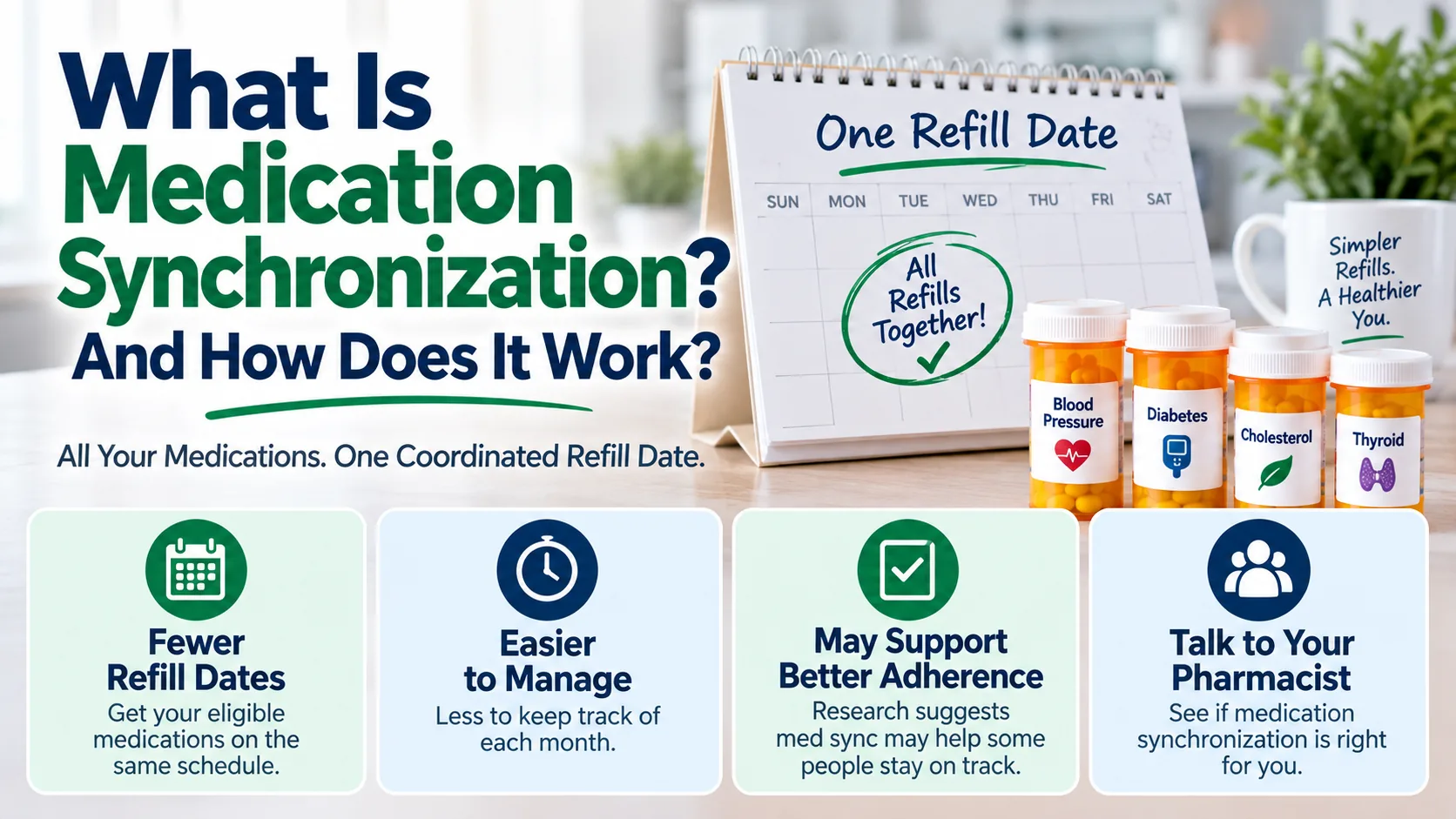
Medication synchronization is a way of coordinating prescription refills so that eligible ongoing medications follow a more consistent refill schedule.
Refill alignment is one of the central features identified in medication-synchronization programs. Other parts of these programs can vary and may include reviewing a patient's medications, contacting the patient before refills are prepared, identifying prescription changes, and coordinating pickup or delivery.
For someone taking several ongoing medications, this can reduce the need to manage multiple unrelated refill dates throughout the month.
How Does Medication Synchronization Work?
The process generally begins by reviewing a patient's ongoing prescriptions and determining which ones may be appropriate to synchronize. The pharmacy then works toward aligning eligible prescriptions to a coordinated refill schedule.
Once the prescriptions are aligned, some synchronization programs contact the patient before the scheduled refill date. This provides an opportunity to confirm which prescriptions are still needed and identify changes before medications are prepared. Programs differ, however, so patients should ask their pharmacy how its synchronization process works.
A Simple Example
Suppose someone has three eligible ongoing prescriptions, but each one currently runs out at a different point during the month.
Rather than continuing with three separate refill schedules, an initial fill of one or more eligible prescriptions may sometimes be adjusted so their future refill dates can be brought into closer alignment. After that initial alignment, the prescriptions may be refilled on a coordinated schedule.
This is only an example. The actual process depends on the prescriptions involved, applicable insurance requirements, and whether each medication is appropriate for synchronization.
How Are Different Prescription Refill Dates Synchronized?
One way to align prescriptions is through a shorter initial fill of an eligible medication.
For example, if one eligible prescription is due well before another, the pharmacy may sometimes dispense less than the usual supply during the alignment process. A later refill can then occur closer to the coordinated refill date.
This does not mean patients should change how much medication they take or alter their prescribed directions. Synchronization concerns the quantity dispensed for an eligible refill, not changing the prescribed dose on your own.
New York note: New York law provides for prescription synchronization under specified circumstances and permits prorated cost sharing for qualifying shorter fills under applicable prescription coverage when the legal requirements are met.
Which Medications Can Be Included in Medication Synchronization?
Not every prescription can necessarily be synchronized.
Whether a medication can be included may depend on factors such as whether it is an ongoing maintenance medication, whether refills remain, the medication itself, the prescribed supply, insurance requirements, and applicable pharmacy and controlled-substance rules.
For New York Medicaid members: The NYRx Medication Synchronization Program targets maintenance medications with the same day supply. NYRx states that controlled substances and medications used for acute or short-term therapy are not eligible for its synchronization program.
Your pharmacist can review your prescriptions and determine which medications may be appropriate to include rather than assuming that every prescription can be placed on the same schedule.
What Are the Potential Benefits of Medication Synchronization?
The main practical purpose of medication synchronization is to make refill timing easier to manage for people with eligible ongoing prescriptions.
Fewer Refill Dates to Keep Track Of
Without synchronization, someone taking several medications may have prescriptions coming due at different points throughout the month.
Coordinating eligible refills can reduce the number of separate refill schedules a patient has to keep track of. Some synchronization models are designed around a recurring pharmacy pickup date, although programs and individual arrangements can differ.
Medication Synchronization May Support Adherence
Research suggests that medication-synchronization programs may support medication adherence for some patients.
A 2021 meta-analysis of nine U.S. studies found that participation in medication-synchronization programs was associated with greater odds of adherence among adults taking chronic medications. However, there was substantial variation among the studies and among the synchronization programs evaluated.
An earlier systematic review of appointment-based synchronization also found improvements in objective measures of medication-taking behavior, while noting that evidence concerning several downstream outcomes—including clinical outcomes and healthcare utilization—was limited or inconclusive.
Medication synchronization therefore should not be understood as a guarantee that doses will not be missed or that health outcomes will improve. It is one medication-management approach that may make refill organization easier and may support adherence for some people.
Medication Synchronization vs. Automatic Refills: What's the Difference?
Medication synchronization and automatic refills are not necessarily the same thing.
Medication synchronization coordinates when eligible prescriptions are due for refill.
Automatic refill generally refers to a process in which a prescription refill is initiated according to a pharmacy or plan's refill process without the patient having to make a new refill request each time.
Some appointment-based synchronization models contact patients before the coordinated refill date to confirm which prescriptions are needed and identify medication changes before the prescriptions are prepared.
The distinction can also matter under specific insurance programs. NYRx states that medication-synchronization refills under the New York Medicaid Pharmacy Program are not eligible for automatic refill.
Because pharmacy and insurance procedures vary, ask your pharmacist how refills are confirmed under the synchronization program you are considering.
Medication Synchronization vs. Blister Packs: What's the Difference?
Medication synchronization and medication blister packaging address different parts of medication management.
Medication synchronization coordinates refill timing for eligible prescriptions.
Medication blister packs organize eligible medications into labeled compartments according to the prescribed schedule, such as by day, scheduled time, or both.
A patient may potentially use both services when appropriate, but having synchronized prescriptions does not automatically mean the medications will be packaged in blister packs, and using blister packs does not necessarily mean all prescriptions are synchronized.
For a closer look at medication packaging, read What Are Medication Blister Packs and How Do They Work?
What Happens if a Prescription Changes?
A synchronized refill schedule may need to be adjusted when a prescription changes.
For example, a prescriber may change the dose or frequency, discontinue a medication, prescribe a different medication, or add a new prescription. Some appointment-based synchronization programs specifically contact patients before their scheduled refill date so medication changes can be identified before prescriptions are prepared.
New York's prescription-synchronization provisions also recognize circumstances in which another synchronization adjustment may be necessary after a prescriber changes a medication's dosage or frequency or prescribes a different drug.
If one of your prescriptions changes, tell your pharmacy rather than assuming the existing synchronized refill schedule will continue unchanged.
Who Might Find Medication Synchronization Helpful?
Medication synchronization may be useful for someone who takes multiple eligible ongoing medications and currently manages several different refill dates.
It may be especially worth discussing with a pharmacist if different prescriptions repeatedly become due at different points during the month or keeping track of separate refill schedules has become inconvenient.
That does not mean medication synchronization is necessary or appropriate for everyone. The pharmacist needs to consider the actual prescriptions involved and determine which ones can appropriately be synchronized.
Questions to Ask Your Pharmacist About Medication Synchronization
If you are considering medication synchronization, useful questions include:
- Which of my prescriptions can be synchronized?
- Will any of my prescriptions need a shorter initial fill to align the refill dates?
- How will I know when my synchronized prescriptions are ready?
- Will the pharmacy contact me before preparing the synchronized refills?
- What should I do if my prescriber changes or stops one of my medications?
- Can medication synchronization be used together with medication blister packaging?
- Are there insurance requirements that apply to my prescriptions?
Preferred Pharmacy's Medication Packaging & Management service includes medication-management options for eligible prescriptions. Your pharmacist can review your medication list and explain which options may be appropriate for your prescriptions.
Watch: How Medication Synchronization Works
Watch this Preferred Pharmacy Education Series video for a concise explanation of medication synchronization and how eligible prescription refill dates can be coordinated.
Frequently Asked Questions
Do all of my prescriptions have to be synchronized?
No. Medication synchronization can involve eligible ongoing prescriptions without assuming that every medication a person takes belongs on the same refill schedule. Eligibility depends on the individual prescriptions and applicable requirements.
Can controlled substances be included in medication synchronization?
The answer depends on the medication and applicable rules. Under New York's NYRx Medication Synchronization Program, controlled substances are not eligible. Other New York prescription-synchronization provisions also contain specific controlled-substance restrictions. Ask your pharmacist about the prescriptions on your medication list rather than assuming a controlled medication can be synchronized.
Does medication synchronization mean my prescriptions are automatically refilled?
Not necessarily. Synchronization concerns coordinating refill dates, while automatic refill concerns how a refill is initiated or processed. Procedures vary by pharmacy and insurance program, and NYRx specifically states that its medication-synchronization refills are not eligible for automatic refill.
What happens if my doctor changes one of my prescriptions?
Tell your pharmacy about the change. A different dose, frequency, medication, or other prescription change can affect the synchronized schedule and may require the pharmacy to adjust it.
Can medication synchronization be used with blister packs?
Potentially, when the prescriptions involved are appropriate for both services. The two services perform different functions: synchronization coordinates refill timing, while blister packaging organizes eligible medications according to the prescribed schedule. Your pharmacist can determine what is appropriate for your medication list.
Sources & References
This article was developed using current guidance and information from authoritative health and medical sources.
- American Pharmacists Association Foundation — Pharmacy's Appointment-Based Model Describes refill synchronization, advance patient contact, and the appointment-based pharmacy model.
- Systematic Review of Medication Synchronization in Community Pharmacy Practice Reviews community-pharmacy medication synchronization programs and identifies refill alignment and other common program components.
- The Impact of Medication Synchronization Programs on Medication Adherence: A Meta-analysis Evaluates medication-adherence outcomes across nine U.S. studies while documenting substantial variation among studies and synchronization programs.
- New York State Department of Health — NYRx Medication Synchronization Program Implementation Provides New York Medicaid-specific information concerning medication-synchronization eligibility and automatic-refill requirements.
- New York State Insurance Law § 3224-d — Prescription Synchronization Provides New York requirements concerning qualifying prescription synchronization and prorated cost sharing for applicable shorter fills.
This article is for general educational and informational purposes only and is not a substitute for personalized medical advice. Talk with your pharmacist or healthcare provider about questions concerning your medications or health conditions.