A medication blister pack is a pharmacy-prepared packaging system that organizes eligible medications into separate compartments. Depending on the type of pack and a person's prescriptions, the compartments may be arranged by day and scheduled time, making it easier to see which packaged medications are intended to be taken together.
Instead of managing several prescription bottles separately, a patient can use the labeled compartments to follow the medication schedule prepared by the pharmacy. Not every medication is appropriate for blister packaging, however. The pharmacy must determine which medications can be included based on the prescription, dosage form, storage and stability considerations, and other medication-specific factors.
Key Takeaways
- Medication blister packs organize eligible medications into separate labeled compartments.
- Compartments can be arranged according to a person's prescribed medication schedule.
- Packaging may make a routine involving several medications easier to organize for some people.
- Not every medication can or should be removed from its original packaging and placed into a blister pack.
- If a prescription changes, contact the pharmacy before making changes to an existing pack.
What Is a Medication Blister Pack?
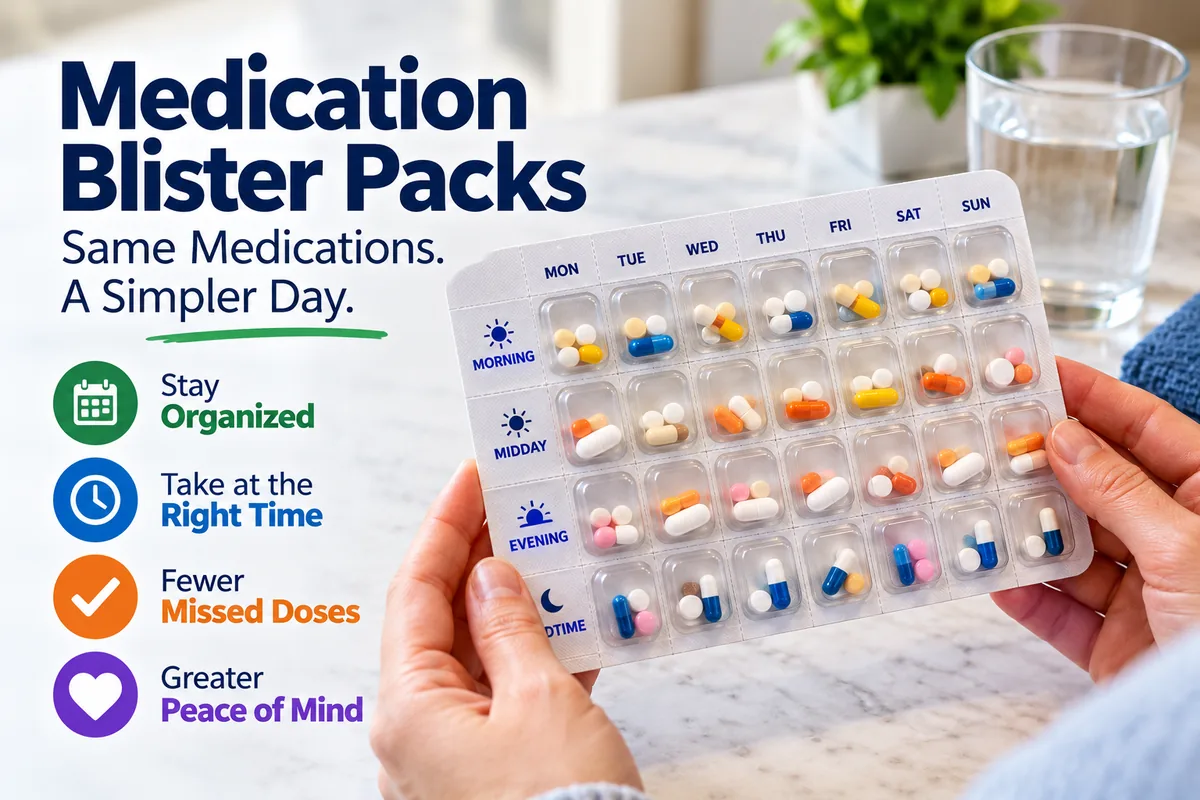
A medication blister pack is a type of medication organizer prepared for an individual patient's prescriptions. Medications are placed into separate compartments so that doses scheduled for particular days or times can be grouped and labeled.
In professional pharmacy guidance, these systems may also be called multi-compartment compliance aids, monitored dosage systems, or dose administration aids. The terminology and physical design can vary.
This is different from simply buying an empty pill organizer and filling it yourself. With pharmacy-prepared packaging, the pharmacy reviews the prescriptions and determines which medications are appropriate to package.
It is also useful to distinguish these packs from manufacturer blister packaging. Some medications are manufactured and sold with individual tablets or capsules already sealed in blisters. A pharmacy-prepared medication pack, by contrast, is created to organize eligible medications around an individual patient's prescribed regimen.
How Do Medication Blister Packs Work?
The process starts with the patient's current prescriptions. The pharmacy reviews the medication regimen and determines which medications are appropriate for the packaging system being used.
Eligible medications can then be organized into labeled compartments according to the prescribed schedule. Depending on the system, a pack might separate medications by day, by time of day, or both.
For example, medications prescribed for the same scheduled time may be packaged together in one compartment, while medications scheduled for another time are placed separately. The exact layout and labeling depend on the packaging system and the person's prescriptions.
When it is time for a scheduled dose, the patient opens the appropriate compartment and removes the packaged medications.
Because packaging systems differ, patients should follow the directions and labeling provided with their own medication pack rather than assuming that every blister pack works the same way.
Watch: What Are Medication Blister Packs and How Do They Work?
Watch this Preferred Pharmacy Education Series video for a quick overview of how medication blister packs work and how they can help organize eligible medications.
How Are Medications Organized in a Blister Pack?
The main purpose of pharmacy-prepared blister packaging is to organize medications according to the prescribed regimen.
A pack may identify information such as the day or scheduled administration time associated with a compartment. This can reduce the need to sort through several prescription bottles each time medications are scheduled.
The arrangement is based on the patient's prescriptions, so it may look different from one person to another.
Understanding the medications you take is still important even when they are organized into packaging. Patients should continue to know what medications have been prescribed and follow the directions provided by their pharmacy and healthcare providers.
If you would like help understanding the information that comes with a prescription, see How to Read a Prescription Label: What the Information on Your Bottle Means .
How Can Blister Packs Help With Multiple Medications?
For someone taking several scheduled medications, keeping track of different bottles and directions can become complicated. Blister packaging can place eligible medications into an organized format so the patient does not have to sort the same medications from multiple containers for each scheduled dose.
Research on medication-packaging interventions suggests that packaging can support medication adherence for some patients, but the effect varies and packaging alone does not guarantee that medications will be taken correctly. Professional guidance also emphasizes that these systems should be used when they are appropriate for the individual rather than automatically for everyone.
For that reason, it is more accurate to think of blister packaging as an organizational tool. It may simplify a medication routine, but it does not replace understanding the medications, following current directions, or asking questions when something is unclear.
Can Every Medication Go Into a Blister Pack?
No. Not every medication is appropriate for blister packaging.
Moving a medication from its manufacturer's original container into another packaging system can change the conditions in which it is stored. Stability can depend on the medication itself, its dosage form, the packaging material, temperature, humidity, light, and other factors. Research has also shown that different products may respond differently after repackaging.
Current professional guidance therefore recommends assessing the suitability and stability of medications before placing them into multi-compartment packaging.
Some medications may need to remain in their original or separate packaging. Patients should not assume that a medication belongs in a blister pack simply because it is a tablet or capsule.
The pharmacist can determine which medications are appropriate for the packaging system being used.
What Happens if Your Prescription Changes After the Pack Is Prepared?
Medication regimens can change. A prescriber may stop a medication, change a strength or dose, or add something new after a blister pack has already been prepared.
If that happens, contact the pharmacy for instructions about the existing pack.
Do not assume that you should remove, replace, add, or rearrange medication in a prepared pack on your own. The pharmacy can review the new prescription information and determine what needs to happen with the current packaging and future packs.
Professional guidance specifically recognizes medication changes as an important consideration when multi-compartment medication systems are being used.
If something inside your pack looks different from what you expected, or the labeling does not match the directions you believe you were given, check with the pharmacy before taking the medication.
Are Blister Packs and Medication Synchronization the Same Thing?
No. Medication packaging and medication synchronization address two different parts of medication management.
Medication blister packaging organizes eligible medications according to the prescribed medication schedule.
Medication synchronization, often called Med Sync, helps coordinate eligible prescription refill dates so that medications can be refilled on a more coordinated schedule.
The two services can work together, but they are not the same thing.
Who Might Find Medication Blister Packs Helpful?
Medication packaging may be useful for some people who take several scheduled medications and want a more organized way to manage their routine.
It may also be useful in some situations where a family member or caregiver helps someone manage medications.
But blister packaging is not automatically the right solution for everyone. A person's medication regimen, ability to use the packaging, support needs, and the suitability of the individual medications all matter. Professional guidance recommends an individualized assessment rather than routine use for every patient.
Some people may also find certain packaging difficult to open or use. If opening, reading, or handling a medication pack is difficult, tell your pharmacist so other options can be considered.
Questions to Ask Your Pharmacist About Blister Packaging
If you are considering medication packaging, useful questions include:
Questions to Ask
- Which of my medications can be included in the pack?
- Will any of my medications need to stay in their original containers?
- How will the compartments be organized and labeled?
- What should I do if my prescription or dose changes?
- What should I do if a medication in the pack looks different than expected?
- Who should I contact if I have questions about the directions?
These questions can help make sure you understand both how the packaging works and how it fits into your medication routine.
Frequently Asked Questions
Here are answers to some common questions about medication blister packaging.
Are blister packs and bubble packs the same thing?
The terms are sometimes used to describe similar compartment-style medication packaging, but terminology and packaging designs can vary. If you are unsure what type of packaging a pharmacy provides, ask to see an example and have the pharmacy explain how it is organized.
Can all of my medications go into a blister pack?
No. Medication suitability depends on factors such as the medication, dosage form, directions, stability and storage requirements, and the packaging system being used. Some medications may need to remain separately packaged.
Can vitamins and over-the-counter medications go into a blister pack?
It depends on the specific product and the pharmacy's packaging process. Do not add vitamins, supplements, or over-the-counter medications to a pharmacy-prepared pack yourself. Ask the pharmacist whether a particular product can appropriately be included.
What if my medication or dose changes?
Contact the pharmacy and explain what changed. The pharmacy can determine how the change affects your existing pack and what should be done with future packaging. Do not assume that a prepared pack should be altered at home.
Are blister packs the same as pill packs?
The terms may be used differently depending on the pharmacy and packaging system. Both can refer to ways of organizing medications into individual doses or scheduled groups, but the physical format can differ. Ask the pharmacy how its specific system is organized rather than relying on the name alone.
Are blister packs the same as medication synchronization?
No. Blister packaging organizes eligible medications according to a prescribed schedule. Medication synchronization coordinates eligible prescription refill dates. They may be used together, but they perform different functions.
Medication Packaging at Preferred Pharmacy
Preferred Pharmacy offers medication packaging for eligible medications as part of our medication-management services. Our pharmacy team can review your medication routine, explain how the packaging works, and determine which medications may be appropriate to include.
Learn more about Medication Packaging at Preferred Pharmacy .
Sources & References
This article was developed using current professional guidance and peer-reviewed research concerning multi-compartment medication packaging, medication adherence, and medication stability.
- NHS Specialist Pharmacy Service — Complex Medication Regimens: Supporting Adherence Professional guidance addressing complex medication regimens, multi-compartment compliance aids, patient suitability, and medication changes.
- NHS Specialist Pharmacy Service — Using the Medicines Compliance Aid Stability Tool Professional guidance on assessing whether individual solid dosage forms are suitable for inclusion in multi-compartment compliance aids.
- Conn VS, Ruppar TM, Chan KC, et al. — Packaging Interventions to Increase Medication Adherence: Systematic Review and Meta-Analysis Systematic review and meta-analysis evaluating pill-box and blister packaging interventions and medication adherence.
- Albert V, Lanz M, Imanidis G, et al. — Stability of Medicines After Repackaging Into Multicompartment Compliance Aids Peer-reviewed research examining visual stability considerations for solid oral medicines after repackaging into multi-compartment compliance aids.
- Raimi-Abraham BT, Garcia del Valle A, Varon Galcera C, et al. — Investigating the Physical Stability of Repackaged Medicines Stored Into Commercially Available Multicompartment Compliance Aids Peer-reviewed research examining physical stability after selected medicines were repackaged into commercially available multi-compartment compliance aids.
This article is for general educational and informational purposes only and is not a substitute for personalized medical advice. Talk with your pharmacist or healthcare provider about questions concerning your medications or health conditions.