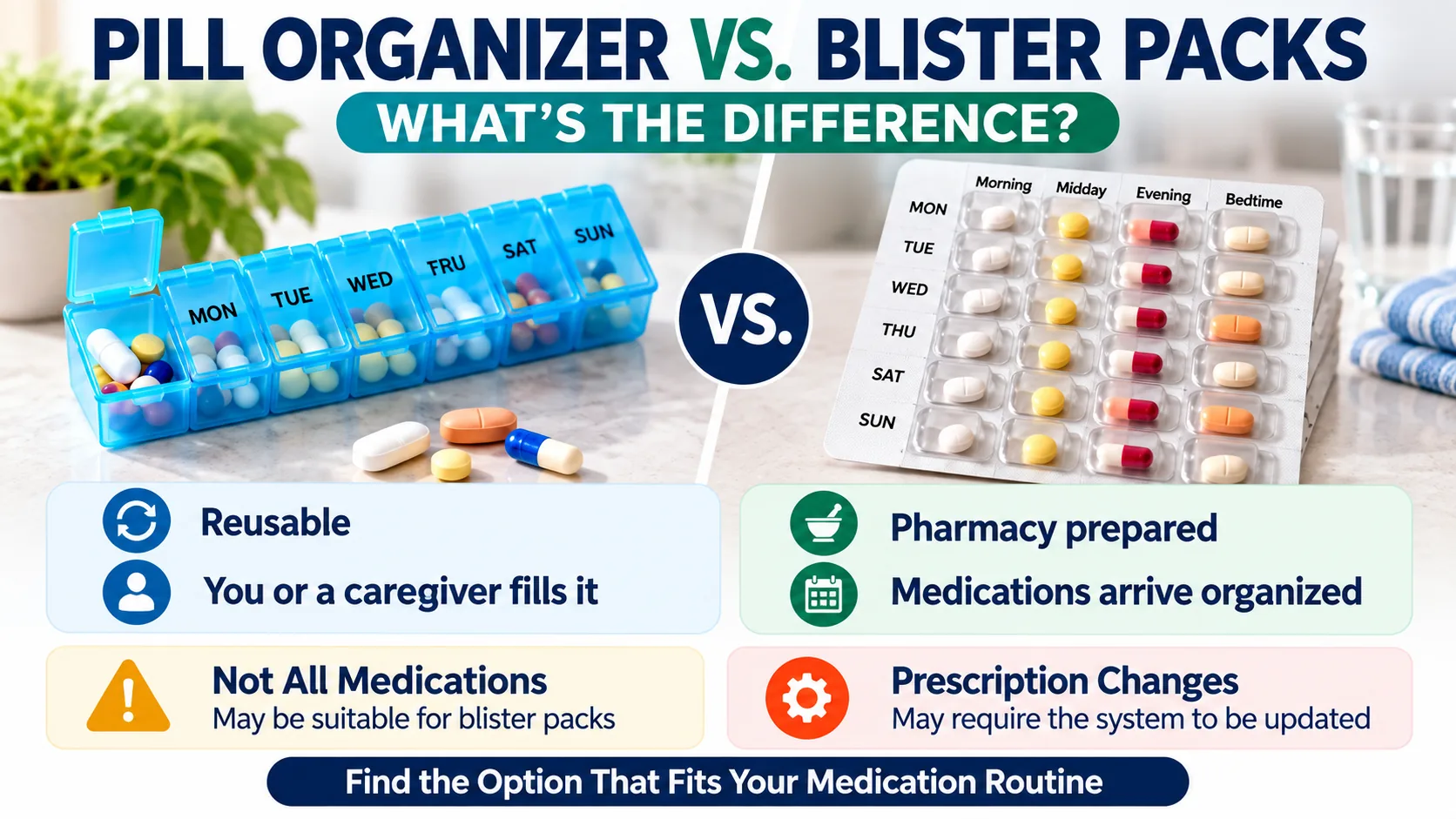
A pill organizer is a reusable container with compartments that can separate medications by day, time of day, or both. It is commonly filled by the person taking the medications or by a caregiver.
Pharmacy-prepared blister packs work differently. Eligible medications are organized in sealed compartments according to the prescribed medication schedule before the packaging is provided to the patient.
Both approaches can help organize medications, but they differ in who prepares them, how they are used, and how prescription changes are handled. Not every medication is necessarily appropriate for blister packaging, so a pharmacist can help determine which medications and medication-management options may be suitable for an individual prescription routine.
Key Takeaways
- Pill organizers are reusable and generally need to be filled again for each medication cycle.
- Pharmacy blister packs are prepared in advance, with eligible medications organized into sealed compartments.
- Both approaches can organize medications according to a schedule, depending on the particular system.
- Not every medication is necessarily appropriate for blister packaging.
- Prescription changes can require the medication organization system to be updated.
- Neither option is automatically best for everyone.
What Is a Pill Organizer?
A pill organizer—sometimes called a pill box—is a reusable container divided into compartments for medications. Some have one compartment for each day, while others provide several compartments per day for different scheduled medication times.
Unlike professionally prepared blister packs, pill organizers do not necessarily require professional preparation. They may be filled by the person taking the medications, a caregiver, or in some circumstances a healthcare professional.
Once the medications in an organizer have been taken, the organizer can be filled again for the next cycle.
What Are Pharmacy Blister Packs?
Medication blister packs are a different type of medication organization system.
Instead of requiring someone at home to sort medications into a reusable container, eligible medications can be professionally prepared into sealed compartments according to the prescribed medication schedule.
The compartments can help show which packaged medications are scheduled for a particular day or time.
For a more detailed explanation, see What Are Medication Blister Packs and How Do They Work?
Pill Organizer vs. Blister Packs: What Are the Key Differences?
The easiest way to understand the difference is to look at who organizes the medications and how the system is prepared.
| Feature | Pill Organizer | Pharmacy Blister Packs |
|---|---|---|
| Who prepares it? | Commonly the patient or caregiver | Professionally prepared |
| Reusable? | Generally yes | Individual sealed packages are used as prepared |
| Medication organization | Compartments can separate medications by day or time | Eligible medications can be packaged according to the prescribed schedule |
| Sorting at home | Usually required | Eligible packaged medications arrive already organized |
| After a prescription change | The organizer may need to be reorganized | The pharmacy may need to adjust future packaging |
The systematic-review literature uses essentially this distinction: pill boxes are reusable multicompartment containers that can be filled by patients or caregivers, while blister packs are professionally prepared sealed medication packages.
What Are Some Advantages of a Pill Organizer?
Simple and Reusable
A pill organizer can provide a relatively simple way to separate medications according to a schedule.
Because the container itself is reusable, it can be filled again after the medications from the previous cycle have been taken.
Flexible for Different Schedules
Pill organizers are available with different compartment arrangements. Depending on the organizer, medications can be separated by day or into multiple scheduled times during the day.
However, someone still needs to correctly place the medications into those compartments.
What Are Some Advantages of Pharmacy Blister Packs?
Medications Arrive Organized
One important difference is that eligible medications can arrive already organized rather than requiring the patient or caregiver to sort them into a pill organizer at home.
That may be useful for some people managing multiple ongoing prescriptions.
Less Medication Sorting at Home
Because the packaging is prepared before it reaches the patient, there may be less medication sorting required at home for the medications included in the packaging.
Research has examined both pill boxes and blister packs as medication-adherence interventions. A systematic review and meta-analysis found an overall adherence benefit from packaging interventions and reported larger effects among blister-pack studies than pill-box studies. However, the studies varied considerably, and the authors identified limitations including publication bias and limited reporting of health outcomes. Those findings therefore should not be interpreted to mean that blister packs are the better choice for every individual.
Can Every Medication Go Into a Blister Pack?
Not necessarily.
Whether a medication can appropriately be included can depend on the particular medication, dosage form, prescription instructions, stability and storage considerations, and other medication-specific factors.
Some medications may therefore remain in their original or separate packaging even when a person uses blister packs for other prescriptions.
A pharmacist can review the medication list and determine which prescriptions may be appropriate for the packaging system being considered.
What Happens if a Prescription Changes?
Medication regimens can change.
A prescriber might change a dose, discontinue a medication, or prescribe something new. When that happens, the medication organization system may also need to change.
If medications have already been sorted into a pill organizer or prepared in blister packaging, contact the pharmacist or other appropriate healthcare professional for guidance rather than assuming how the existing medications should be rearranged.
For pharmacy-prepared packaging, the pharmacy may also need to update future packages to reflect the new prescription instructions.
Which Option Might Fit Your Medication Routine?
There is no single medication-organization method that is appropriate for everyone.
Factors worth discussing with a pharmacist can include:
- how many ongoing medications you take;
- how often those medications are scheduled;
- whether you are comfortable accurately filling an organizer;
- whether someone helps manage your medications;
- how frequently your prescriptions change; and
- whether your medications are appropriate for the packaging system being considered.
The purpose of the conversation is not simply to determine whether a pill organizer or blister pack is universally “better.” It is to find a practical and appropriate way to organize a person's particular medication routine.
Can Medication Synchronization Be Used With Blister Packs?
Medication synchronization and blister packaging solve different medication-management problems.
Medication synchronization focuses on coordinating when eligible prescriptions are due for refill.
Blister packaging focuses on how eligible medications are organized according to the prescribed schedule.
Depending on the prescriptions and pharmacy program, these approaches may be used together.
For more information, see What Is Medication Synchronization and How Does It Work?
Questions to Ask Your Pharmacist
If you're considering a pill organizer or pharmacy-prepared medication packaging, useful questions may include:
- Which of my medications could be included in blister packaging?
- Would any of my medications need to remain separate?
- What should I do if my prescription or dose changes?
- How are newly prescribed medications handled?
- Could medication synchronization be used with my medication-management plan?
Medication Packaging at Preferred Pharmacy
Preferred Pharmacy's Medication Packaging & Management service includes medication-management options for eligible prescriptions.
A pharmacist can review your medication list and explain which medication-management options may be appropriate for your prescriptions.
Watch: Pill Organizer vs. Blister Packs
Watch this Preferred Pharmacy Education Series video to learn how pill organizers and pharmacy-prepared blister packs work and understand some of the important differences between them.
Frequently Asked Questions
Are pill organizers and blister packs the same thing?
No. A pill organizer is generally a reusable multicompartment container that must be filled with medications. Pharmacy-prepared blister packs contain eligible medications that have already been organized into sealed compartments according to the prescribed schedule.
Do I have to fill a pharmacy-prepared blister pack myself?
No. The defining distinction of the pharmacy-prepared blister packaging discussed here is that the medications are organized into the package before it is provided to the patient.
Can all of my medications go into a blister pack?
Not necessarily. Whether a medication can be included depends on medication- and prescription-specific factors. A pharmacist should review the medication list to determine what can appropriately be packaged.
What should I do if my prescription changes after my blister packs are prepared?
Contact your pharmacist or healthcare provider for guidance. A dose change, discontinued medication, or newly prescribed medication may require the medication-management plan and future packaging to be updated.
Sources & References
This article was developed using peer-reviewed research on medication packaging and medication-adherence interventions.
- Conn VS, Ruppar TM, Chan KC, et al. Packaging interventions to increase medication adherence: systematic review and meta-analysis. Current Medical Research and Opinion. Reviews pill boxes and professionally prepared blister packaging and evaluates medication packaging interventions.
- Mahtani KR, Heneghan CJ, Glasziou PP, Perera R. Reminder packaging for improving adherence to self-administered long-term medications. Review of reminder-packaging interventions for long-term medication use and the limitations of the available evidence.
- Boeni F, Spinatsch E, Suter K, Hersberger KE, Arnet I. Effect of drug reminder packaging on medication adherence: a systematic review revealing research gaps. Systematic Reviews. Examines reusable multicompartment aids, pharmacy-filled multidrug packaging and other reminder-packaging approaches.
This article is for general educational and informational purposes only and is not a substitute for personalized medical advice. Talk with your pharmacist or healthcare provider about questions concerning your medications or health conditions.