Direct Answer
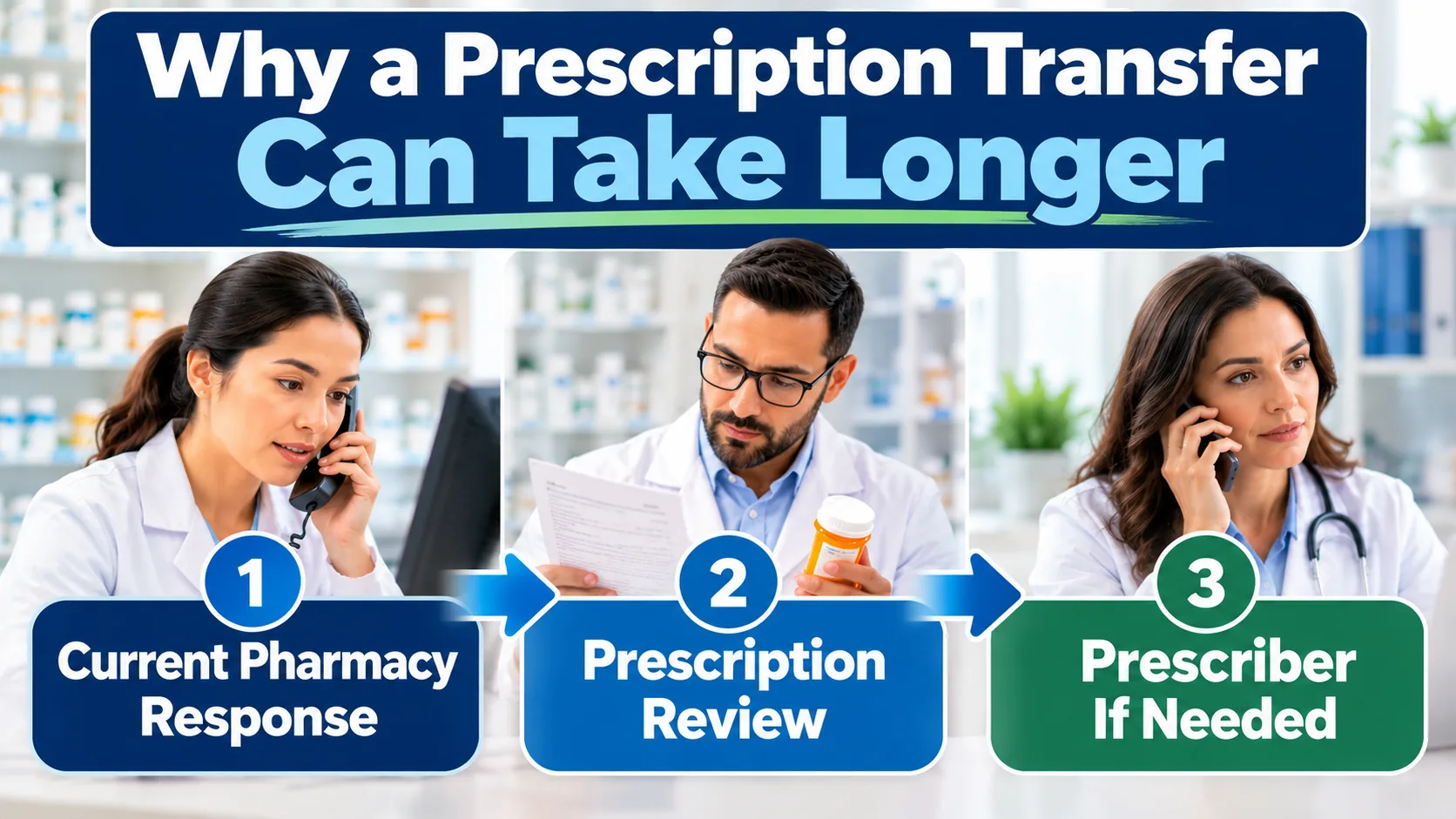
A prescription transfer can take longer than expected when the pharmacies need additional time to exchange or verify prescription information, the current pharmacy has not yet responded, the prescription requires additional review, or a new prescription is needed from the prescriber.
A transfer request also does not necessarily mean the medication is immediately ready to be filled. After the prescription information reaches the new pharmacy, additional processing may still be necessary before the prescription is ready.
If you are waiting for a transfer and are concerned about the timing, contact the receiving pharmacy. The pharmacy can check the status of the request and tell you whether another step is needed.
Key Takeaways
- There is no single guaranteed completion time for every prescription transfer.
- The receiving pharmacy may need to obtain information directly from your current pharmacy.
- A delay can occur while the pharmacies communicate or verify the prescription information.
- If the prescription cannot be transferred as requested or no valid refills remain, the prescriber may need to become involved.
- Completing the transfer and having the medication ready to fill are not necessarily the same step.
- Starting a transfer before you are about to run out of medication can provide more time to address unexpected issues.
- If a transfer appears delayed, the receiving pharmacy is a good place to ask what is still needed.
How Long Does a Prescription Transfer Usually Take?
There is no universal transfer time that applies to every prescription.
Some transfers can be completed relatively quickly, while others may take longer depending on the prescription and circumstances. One important factor is how quickly the pharmacy that currently holds the prescription responds to the receiving pharmacy's request.
For example, some pharmacies and health systems advise patients that transfers may take anywhere from several hours to one or more business days. Those estimates are useful for planning, but they should not be interpreted as a guarantee for an individual prescription.
Preferred Pharmacy advises patients that many prescription transfers can be completed within a few hours, but timing can vary depending on the prescription and how quickly the current pharmacy or prescriber responds.
Why Does the Current Pharmacy's Response Matter?
A prescription transfer is more than simply changing the pharmacy name in a patient's account.
Under New York's current pharmacy regulations, prescription information is transferred between pharmacists, and the pharmacies have documentation requirements associated with the transfer. The transferring pharmacy must provide the necessary prescription information, while the receiving pharmacy must maintain the required transfer record.
Because the pharmacies need to communicate and exchange the appropriate information, the process can take longer when the current pharmacy has not yet responded to the transfer request.
This is one reason transfer timing can vary even when two patients request transfers on the same day.
Can Missing or Incorrect Information Slow Down a Transfer?
Yes.
The receiving pharmacy needs enough information to identify the correct patient, prescription, and pharmacy currently holding the prescription.
Information that can be helpful when requesting a transfer includes:
- your name and date of birth;
- the medication you want transferred;
- the current pharmacy's name and location; and
- prescription information from your medication label, when available.
Having your prescription bottle or label available can make it easier to provide accurate information.
If you need help locating the information on your label, see How to Read a Prescription Label: What the Information on Your Bottle Means .
What If There Are No Refills Remaining?
If there are no authorized refills remaining, the situation may require a new prescription or renewal rather than simply transferring an available refill.
That can add another step because the pharmacy may need to contact the prescriber, and the timing then depends in part on the prescriber's response.
Preferred Pharmacy's transfer guidance similarly explains that if a new prescription is needed, the pharmacy team can contact the prescriber to request one, but the prescriber determines whether a new prescription can be issued.
For more about what happens to existing refills during a transfer, see What Happens to Your Remaining Refills When You Transfer a Prescription?
Does a Completed Transfer Mean the Medication Is Ready?
Not necessarily.
The transfer concerns moving the prescription information to the receiving pharmacy. The pharmacy may still need to process the prescription before it can be filled.
Depending on the circumstances, additional steps could still be necessary before the medication is ready.
This distinction is important when planning around your medication supply: “transfer completed” and “prescription ready” should not automatically be treated as the same thing.
The receiving pharmacy can tell you whether the prescription has been received and what its current status is.
Can the Type of Prescription Affect the Transfer?
Yes.
Transfer requirements can vary depending on the prescription. Controlled-substance prescriptions, in particular, are subject to additional state and federal requirements.
New York's current regulations allow prescription transfers subject to the applicable requirements and specifically provide that controlled-substance transfers remain subject to Article 33 of the Public Health Law and Part 80 of New York's regulations.
Because of these additional requirements, patients should not assume that every prescription can be transferred in exactly the same way or on the same timeline.
We will address this separately in Can Controlled-Substance Prescriptions Be Transferred Between Pharmacies?
What Can You Do to Help Avoid an Unexpected Delay?
Whenever possible, do not wait until the last moment to request a prescription transfer.
You can also help by having accurate information available when making the request, including the medication and current pharmacy information.
If you have several prescriptions, clearly identify which prescriptions you want transferred.
Most importantly, if you are concerned about the status of a transfer, contact the receiving pharmacy. The pharmacy can check whether the prescription information has been received and whether another step is needed.
If you are running low on medication or have concerns about missing doses, contact your pharmacist or healthcare provider rather than making assumptions about what to do.
What Should You Do If Your Transfer Seems Stuck?
Start by contacting the pharmacy that is receiving the prescription.
Ask whether:
- the transfer request has been sent;
- the current pharmacy has responded;
- the prescription information has been received;
- additional information is needed from you; or
- the prescriber needs to be contacted.
That helps identify where the process currently stands instead of assuming that the prescription has been lost or that the transfer failed.
If another party needs to respond, the receiving pharmacy can explain what the next step is.
Transferring a Prescription to Preferred Pharmacy
If you would like to move an eligible prescription to Preferred Pharmacy, our Prescription Transfer service explains how to get started.
Our pharmacy team can contact your current pharmacy to help coordinate the transfer and let you know if additional information or steps are needed.
Watch: Why Is My Prescription Transfer Taking So Long?
Learn why a transfer may take longer than expected and how to check its status.
Frequently Asked Questions
Why is my prescription transfer taking so long?
Timing can vary depending on the prescription and circumstances. A transfer may take longer while the receiving pharmacy waits for the current pharmacy to respond, verifies prescription information, or determines whether another step—such as contacting the prescriber—is required.
How long should I expect a pharmacy transfer to take?
There is no universal guaranteed time. Some transfers may be completed within hours, while others can take longer. Published pharmacy estimates vary considerably, so the receiving pharmacy is the best source for the status of your particular transfer.
Should I call my old pharmacy if the transfer is delayed?
Start with the receiving pharmacy. They can check whether the transfer request has been sent, whether a response has been received, and whether anything else is needed. Depending on the situation, they may tell you that another step is appropriate.
Can a prescription transfer be complete but my medication still not be ready?
Yes. Receiving the transferred prescription information does not necessarily mean that the medication is immediately ready to be dispensed. The receiving pharmacy may still need to process the prescription.
What if I am almost out of medication while waiting for the transfer?
Contact the receiving pharmacy promptly and explain that you are running low. If you have concerns about missing doses or what to do while waiting, speak with your pharmacist or healthcare provider rather than changing how you take your medication on your own.
Sources
- New York State Education Department, Office of the Professions — Part 63: Pharmacy Regulations , including current prescription-transfer requirements.
- Preferred Pharmacy — Prescription Transfer , including current patient-facing transfer timing and process information.
- University Hospitals — Prescription Transfer , noting that transfer turnaround depends in part on response from the originating pharmacy.
- University of Iowa Health Care — Transfer Your Prescriptions , providing patient guidance on transfer processing time and advance planning.
This article is for general educational and informational purposes only and is not a substitute for personalized medical advice. Talk with your pharmacist or healthcare provider about questions concerning your medications or health conditions.