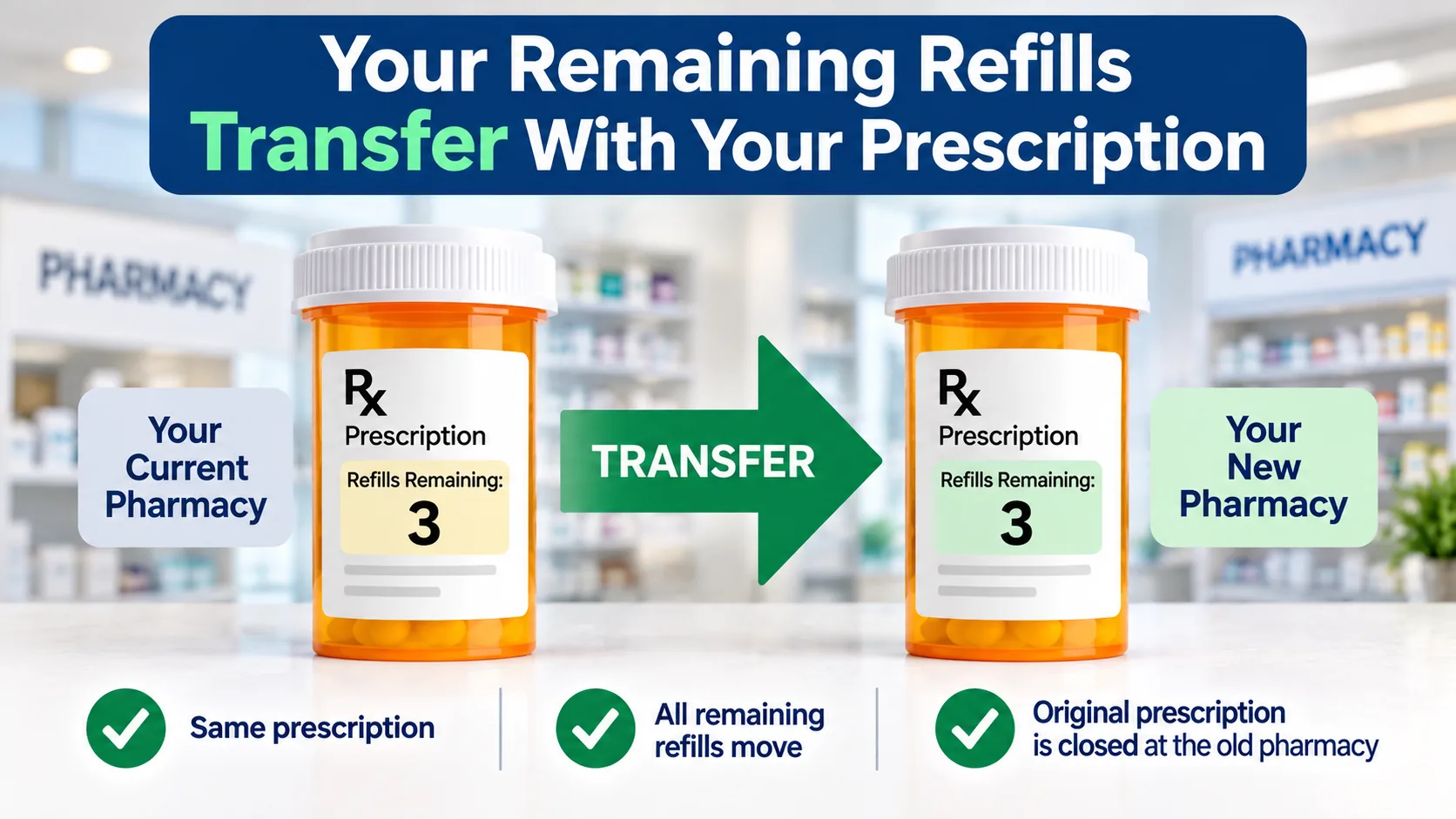
When you transfer a non-controlled prescription to another pharmacy in New York, the remaining authorized refills transfer with the prescription. Under current New York rules, the prescription must be transferred in full, including all remaining authorized refills, rather than transferring one refill at a time.
Once the transfer is completed, the original prescription is invalidated at the transferring pharmacy, and the receiving pharmacy maintains the transferred prescription record, including the number of valid refills remaining.
Key Takeaways
- In New York, a non-controlled prescription is transferred with all remaining authorized refills.
- The prescription is transferred in full rather than one refill at a time.
- After the transfer, the original prescription is invalidated at the transferring pharmacy.
- The receiving pharmacy records how many valid refills remain.
- Having refills remaining does not necessarily mean the medication can be filled immediately.
- If no refills remain, you may need a new prescription or renewal rather than a refill transfer.
- Controlled-substance prescriptions have additional requirements and should not be assumed to follow exactly the same rules.
Do Your Remaining Refills Transfer With Your Prescription?
For a non-controlled prescription in New York, yes.
Effective October 7, 2025, New York allows a non-controlled prescription, including its remaining authorized refills, to be transferred from one pharmacy to another when expressly requested and approved by the patient or the patient's authorized representative.
Importantly, New York no longer allows pharmacists to transfer just one refill at a time for these prescriptions. The prescription must instead be transferred in full, including all remaining authorized refills.
For example, if an eligible non-controlled prescription has three valid refills remaining when it is transferred, those remaining refills are part of the prescription information transferred to the receiving pharmacy.
What Does “Transferred in Full” Mean?
“Transferred in full” means the transfer involves the prescription and its remaining authorized refills—not simply permission for the new pharmacy to dispense one refill while the rest stay behind at the original pharmacy.
This is a significant change from New York's previous approach, which allowed one authorized refill to be transferred at a time.
Under the current rule, the receiving pharmacist records information that includes the original number of refills authorized and the number of valid refills remaining.
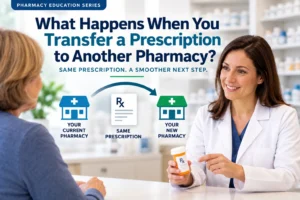
If you'd like an overview of the entire process—not just what happens to the refills—see our guide What Happens When You Transfer a Prescription to Another Pharmacy?
What Happens at Your Old Pharmacy After the Transfer?
Once a non-controlled prescription is transferred, the transferring pharmacist must invalidate the original prescription on file as of the transfer date.
The transferring pharmacy also documents information about the transfer, including the receiving pharmacy, the pharmacists involved, and the date of transfer.
For the patient, the practical point is important: the remaining refills have not simply been copied to another pharmacy while the original prescription continues unchanged at the old pharmacy.
The prescription itself has been transferred.
What Happens at the New Pharmacy?
The receiving pharmacist maintains a complete and accurate record of the transferred prescription.
New York requires the receiving pharmacy's record to identify the prescription as a transfer and document information including the original prescription number, relevant dates, the transferring pharmacy, the pharmacists involved, the original number of authorized refills, and the number of valid refills remaining.
Those records allow the receiving pharmacy to determine the refill information associated with the transferred prescription.
Does Having Refills Remaining Mean You Can Fill the Prescription Immediately?
Not necessarily.
A refill remaining means the prescription still has authorized refills available. That does not automatically mean another fill can be dispensed immediately.
For example, a prescription may have refills remaining but not yet be due for its next fill. Other processing or dispensing requirements may also need to be addressed by the receiving pharmacy.
This distinction is useful because transferring a prescription and filling the prescription are related, but they are not necessarily the same step.
If you're unsure whether a transferred prescription is ready or eligible to be filled, ask the receiving pharmacy about its current status.
What If You Have No Refills Remaining?
If your prescription has no authorized refills remaining, there are no remaining refills to move with the transfer.
In that situation, the next step may involve obtaining a prescription renewal or a new prescription from your prescriber rather than simply requesting another refill.
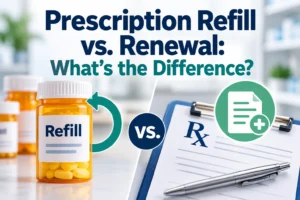
This is why refill and renewal are not interchangeable terms.
We'll explain that distinction in our upcoming Pharmacy Education article, Prescription Refill vs. Renewal: What's the Difference?
Are Controlled-Substance Prescriptions Different?
Yes. Controlled-substance prescriptions are subject to additional state and federal requirements.
New York's current guidance states that, effective April 14, 2026, a controlled-substance prescription may be transferred and filled by another pharmacy subject to applicable New York controlled-substance requirements.
Because the requirements are more specific, patients should not assume that the rules described above for non-controlled prescriptions apply in exactly the same way to every controlled-substance prescription.
We'll address controlled-substance transfers separately in our planned Pharmacy Education article Can Controlled-Substance Prescriptions Be Transferred Between Pharmacies?
How Can You Check How Many Refills You Have Left?
Your prescription label may show information about authorized refills, although the way this information is displayed can vary.
If you're unsure how to interpret the information on your bottle, see our guide to How to Read a Prescription Label: What the Information on Your Bottle Means .
You can also ask your pharmacist to review the prescription record and explain the refill status.
Transferring a Prescription to Preferred Pharmacy
If you would like to move an eligible prescription to Preferred Pharmacy, our Prescription Transfer service explains how to get started.
Our pharmacy team can review the transfer request and let you know if additional information or steps are needed.
Watch: What Happens to Your Refills When You Transfer a Prescription?
Frequently Asked Questions
Do all of my remaining refills transfer to the new pharmacy?
For a non-controlled prescription in New York, the current rule requires the prescription to be transferred in full, including all remaining authorized refills.
Can I leave some refills at my old pharmacy and transfer only one to the new pharmacy?
Under current New York rules for non-controlled prescriptions, no. New York no longer permits pharmacists to transfer only one refill at a time. The prescription must be transferred in full, including its remaining refills.
Can I use a remaining refill immediately after transferring my prescription?
Not necessarily. Having an authorized refill remaining does not by itself establish that the prescription is currently due to be filled. The receiving pharmacy can review the prescription and its current status.
What happens if there are no refills left?
If no authorized refills remain, you may need a prescription renewal or a new prescription from your prescriber rather than simply transferring another refill.
Can controlled-substance refills be transferred the same way?
Do not assume so. Controlled-substance prescriptions are subject to additional state and federal requirements. New York permits certain controlled-substance prescription transfers under rules effective April 14, 2026, subject to applicable requirements.
Sources
- New York State Education Department, Office of the Professions — Prescription Refills .
- New York State Education Department, Office of the Professions — Transfer of Prescriptions .
- New York State Education Department — Part 63 — Pharmacy .
- New York State Education Department, Office of the Professions — Transferring Prescriptions for Non-Controlled Medications .
- New York State Education Department, Office of the Professions — Transferring Prescriptions for Controlled Substances .
This article is for general educational and informational purposes only and is not a substitute for personalized medical advice. Talk with your pharmacist or healthcare provider about questions concerning your medications or health conditions.