When you need more of a medication, you may hear the words refill and renewal. Although they can sound similar, they describe different situations.
Understanding the difference can help you know whether your pharmacy can continue filling an existing prescription or whether new authorization from your prescriber may be needed.
Direct Answer
A prescription refill uses authorization that is still available on an existing prescription. If the prescription is still valid and has authorized refills remaining, the pharmacy may be able to dispense another supply without obtaining a new prescription from the prescriber.
A prescription renewal is generally needed when the existing prescription can no longer be refilled—for example, because there are no authorized refills remaining or the prescription has expired. A renewal requires new authorization from the prescriber, generally in the form of a new prescription.
Key Takeaways
- A refill uses authorization already included with an existing prescription.
- A renewal requires new authorization from the prescriber.
- Having 0 refills remaining generally means the existing prescription cannot simply be refilled again.
- A prescription may sometimes need renewal even if unused refills appear to remain, such as when the prescription is no longer valid.
- Your pharmacy may be able to contact your prescriber about a renewal, depending on the circumstances and applicable requirements.
- A renewal is not automatically approved; the prescriber determines whether to issue a new prescription.
- If you are running low on medication and are unsure whether you need a refill or renewal, contact your pharmacy before changing how you take your medication.
What Is a Prescription Refill?
A prescription refill is another dispensing of medication that was already authorized under an existing prescription.
For example, a prescriber might issue a prescription and authorize additional refills. After the original prescription is filled, those authorized refills may allow the pharmacy to dispense additional supplies while the prescription remains valid.
Each time an authorized refill is used, the number of remaining refills decreases.
Your prescription label may show information about the number of refills remaining. If you are unsure where to find that information, see How to Read a Prescription Label: What the Information on Your Bottle Means .
A refill does not create a new prescription. It uses authorization that already exists on the current prescription.
What Is a Prescription Renewal?
A prescription renewal involves obtaining new authorization from the prescriber when the existing prescription can no longer support another refill.
This commonly happens when:
- all authorized refills have been used;
- the prescription has expired; or
- another circumstance requires a new prescription before additional medication can be dispensed.
The prescriber determines whether a new prescription should be issued.
Depending on the situation, a renewal request may be handled without an appointment, or the prescriber may decide that additional evaluation or a follow-up visit is appropriate before issuing another prescription.
A renewal therefore should not be understood as an automatic extension of the old prescription.
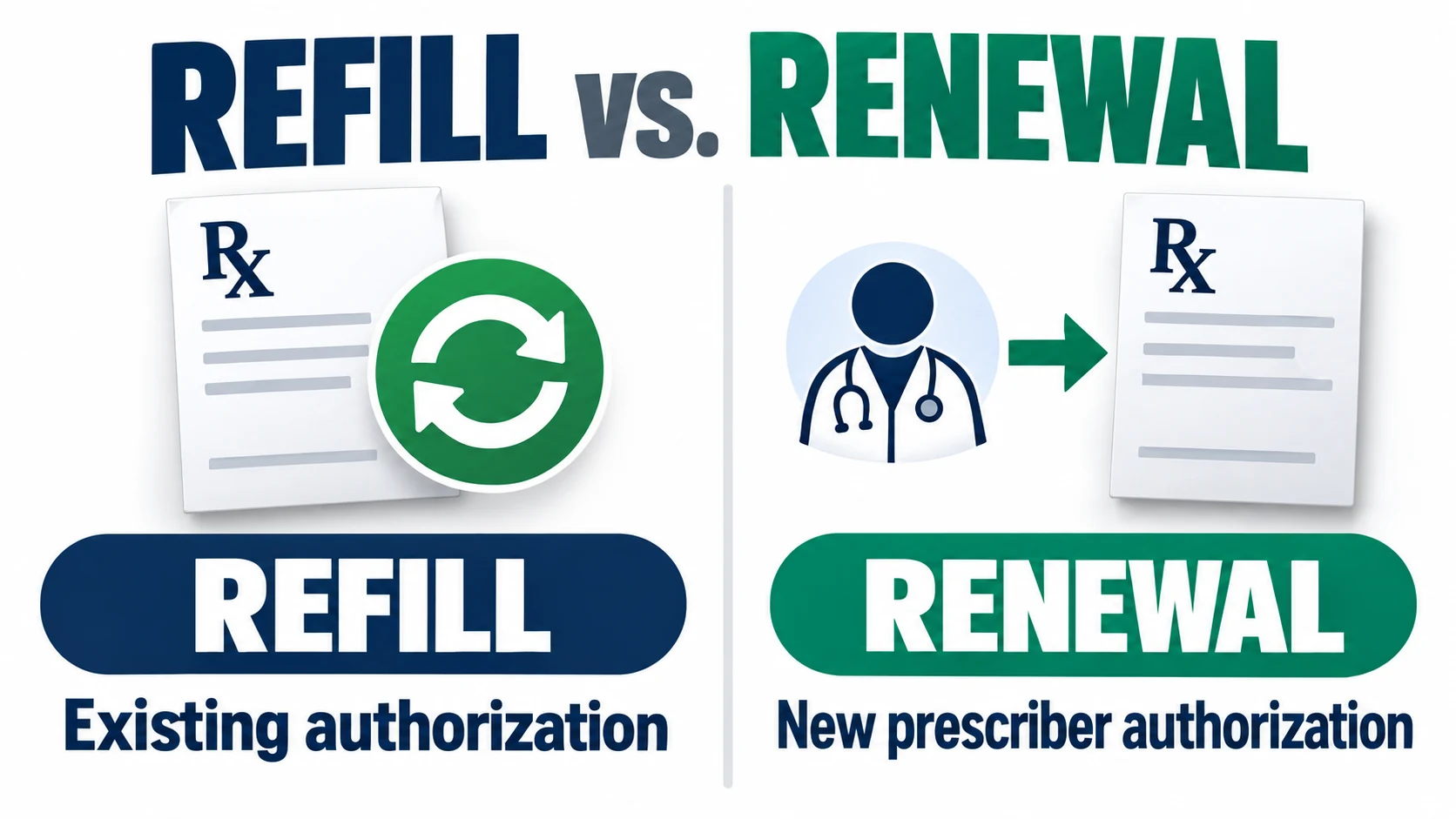
Refill vs. Renewal: What’s the Difference?
Refill → Uses existing prescription authorization
Renewal → Requires new authorization from the prescriber
If your prescription remains valid and has authorized refills available, you are generally requesting a refill.
If the existing prescription can no longer be refilled, you may need a renewal or new prescription from your prescriber.
This difference matters because a refill can usually be handled using information already on file at the pharmacy, while a renewal requires action from the prescriber.
How Can You Tell Whether You Need a Refill or Renewal?
Start by checking your prescription label or contacting your pharmacy.
The label may tell you how many authorized refills remain. Depending on the pharmacy's system, you may also be able to see prescription information through an online account or pharmacy app.
However, the number of refills shown on a label is not always the only factor that determines whether another fill can be completed.
The prescription must also still be valid, and other requirements may apply depending on the medication and circumstances.
If you are unsure, ask your pharmacist to check the prescription record rather than assuming that another refill is available.
What Does “0 Refills Remaining” Mean?
If your prescription shows 0 refills remaining, the authorized refills on that prescription have been used.
That generally means the pharmacy needs new authorization from the prescriber before another supply can be dispensed.
Depending on the situation, you may contact the prescriber directly, or the pharmacy may be able to contact the prescriber about a renewal request.
For New York Medicaid members using NYRx, current state guidance specifically provides several ways a member who has exhausted prescription refills may seek a renewal, including contacting the prescriber directly or asking the pharmacy to contact the prescriber with the member's consent.
The prescriber still determines whether a new prescription will be issued.
Can You Still Need a Renewal If Your Label Shows Refills Remaining?
Yes.
Seeing refills remaining does not necessarily mean that the prescription can continue to be refilled indefinitely.
A prescription can reach the end of its period of validity even when unused refills appear to remain. When that happens, new authorization from the prescriber may be required before additional medication can be dispensed.
For example, current NYRx guidance states that non-controlled prescriptions under that program remain active and refillable for up to one year from the date written. Separate NYRx guidance explains that after a prescription expires, a new prescription is required even when refills remain on the original prescription.
Different requirements can apply depending on the prescription, medication and applicable rules, so your pharmacist can check the status of your specific prescription.
What Happens When You Request a Prescription Renewal?
When a renewal is needed, the prescriber must provide new authorization before the pharmacy can continue dispensing under a new prescription.
Depending on the circumstances, the process may begin when:
- you contact your prescriber;
- you ask the pharmacy to contact the prescriber; or
- another approved communication process is used between you, the pharmacy and the prescriber's office.
The prescriber may issue a new prescription, request additional information, recommend an appointment or decide that another clinical step is appropriate.
Because a renewal requires prescriber involvement, it can take longer than a routine refill.
If you know that your prescription has no refills remaining, requesting help before your medication supply is nearly gone can provide additional time for the renewal process.
How Long Can a Prescription Be Refilled in New York?
Prescription validity and refill requirements depend on the type of prescription and the rules that apply to it.
For example, current New York Medicaid guidance states that non-controlled prescriptions under NYRx remain active and refillable for up to one year from the date written.
That does not mean every prescription can automatically be refilled for a full year. The prescription must have appropriate authorization remaining, and different requirements may apply to certain prescriptions, including controlled substances.
Rather than relying only on the number printed next to “refills,” ask your pharmacist to check whether the prescription remains valid and refillable.
What If You’re Running Low on Medication?
If you notice that you are running low, check your prescription before the medication is gone.
Look at the refill information on your label and contact your pharmacy if you are unsure whether another refill is available.
If a renewal is necessary, additional time may be needed because the prescriber must become involved.
If you are concerned about missing doses while waiting for a refill or renewal, speak with your pharmacist or healthcare provider. Do not change your dose, schedule or how you take the medication on your own simply because you are running low.
How Do Refills and Renewals Affect Prescription Transfers?
Refills and renewals can also matter when you move a prescription from one pharmacy to another.
If an eligible prescription is still valid and has authorized refills remaining, those remaining refills may transfer with the prescription subject to applicable transfer requirements.
If there are no authorized refills remaining—or the prescription otherwise requires new authorization—simply transferring pharmacy information does not create additional refills.
In that situation, a new prescription or renewal from the prescriber may be necessary.
For more about what happens to existing refills during a transfer, see What Happens to Your Remaining Refills When You Transfer a Prescription?
Prescription Refills and Transfers at Preferred Pharmacy
If you would like to move an eligible prescription to Preferred Pharmacy, our Prescription Transfer service explains how to get started.
Our pharmacy team can contact your current pharmacy to help coordinate an eligible transfer and can let you know if the prescription appears to require another step, such as contacting the prescriber.
Watch: Prescription Refill vs. Renewal
Frequently Asked Questions
What is the difference between a prescription refill and a renewal?
A refill uses authorization that is still available on an existing prescription. A renewal requires new authorization from the prescriber, generally because the existing prescription has no authorized refills remaining, has expired or otherwise can no longer be refilled.
What does 0 refills remaining mean?
It generally means that all of the authorized refills on the existing prescription have been used. New authorization from the prescriber may be required before the pharmacy can dispense another supply.
Can I have refills remaining but still need a new prescription?
Yes. Refills shown on a prescription do not necessarily remain usable indefinitely. If the prescription is no longer valid, a new prescription may be required even when unused refills appear to remain.
Can my pharmacy contact my prescriber for a renewal?
In many circumstances, a pharmacy can send or communicate a renewal request to the prescriber. Requirements can vary depending on the prescription, insurance program and circumstances. The prescriber determines whether a new prescription will be issued.
Do I need an appointment to renew a prescription?
Not necessarily. Whether an appointment or additional evaluation is required depends on the medication, your circumstances and the prescriber's clinical judgment. A renewal should not be assumed to require an appointment—or to be automatically approved without one.
What should I do if I am running out of medication and have no refills left?
Contact your pharmacy or prescriber promptly. If you are concerned about missing doses while waiting for a renewal, ask your pharmacist or healthcare provider what to do rather than changing how you take the medication on your own.
Sources
- New York State Department of Health — New York State Medicaid Update, March 2026
- New York State Education Department, Office of the Professions — Education Law Article 137: Pharmacy
- New York State Education Department, Office of the Professions — Part 63: Pharmacy
- Geisinger — Prescription Renewals, Refills and Expired Medicine
This article is for general educational and informational purposes only and is not a substitute for personalized medical advice. Talk with your pharmacist or healthcare provider about questions concerning your medications or health conditions.